
Streaming without the Internet?
The tech is ready but got enemie$. And what does this mean for live sports?

In the grand architecture of modern connectivity, there exists a silent, structural flaw.
It’s a flaw born of success, buried deep within the protocols that govern the internet and reveals itself most acutely when the world tries to watch the same thing at the same time (the FIFA Football World Cup final).
We have built a digital civilization on the backbone of “unicast” communication - a one-to-one exchange where every request generates a unique stream of data. This architecture is a marvel of personalization, enabling the algorithmic feeds of social media and the on-demand libraries of streaming giants. But it’s woefully, mathematically ill-equipped for the communal experience of the live event.
As the world transitions from the era of cable to the era of the cloud, this inefficiency has birthed a crisis of capacity.
Nowhere is this crisis more visceral, or the proposed solution more radical, than in India. While the developed world iterates cautiously on 5G standards and debates the theoretical utility of 6G, India is attempting to engineer a divergent path.
It is building what can be described as a “fourth infrastructure” - a layer of connectivity that sits alongside satellite, cable and cellular data, designed specifically to break the bottleneck of mass media distribution.
This initiative is Direct-to-Mobile (D2M) broadcasting.
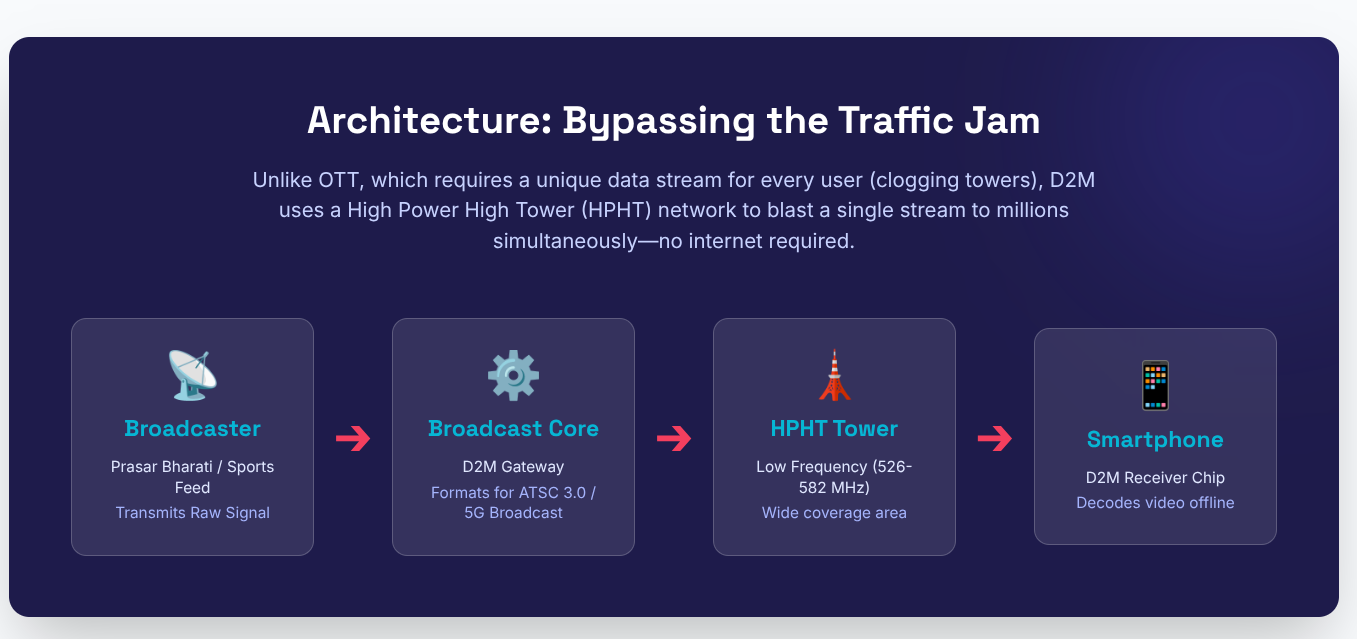
The premise is deceptively simple: harness the physics of terrestrial television - the same “High Power High Tower” architecture that carried analog signals for decades - and digitize it to deliver IP-native video directly to the smartphone, bypassing the cellular network entirely. By operating in the “Goldilocks” spectrum band of 470–582 MHz, D2M promises to decouple high-volume video traffic from the fragile economics of mobile data.
To view D2M merely as a technological upgrade is to miss the forest for the trees.
This isn’t just about watching cricket on a phone without buffering. It’s a calculated geopolitical maneuver and a potential upheaval of the media economy. It represents a battle for the sovereign pipe - a state-backed digital artery that ensures the government can reach its citizenry independent of private telecom conglomerates.
Yes, this is a direct challenge to the Western-led roadmap of 5G Broadcast, positioning India as the standard-bearer for the Global South.
And yes, perhaps most disruptively, it threatens to rewrite the valuation of sports rights, the lifeblood of the global media industry.
Trust me on this one: the D2M ecosystem is a story that needs to be told.
It’s not only about the technology that promises a lot. It’s also about the politics and the regulatory warfare between broadcasters + telcos and the existential threat D2M poses to the subscription economy of live sports.
Breaking the Unicast curse
To understand why the Indian government is investing political capital and spectrum resources into D2M, one must first confront the hard limits of cellular physics. The modern mobile network is a miracle of engineering, but it is constrained by the Concurrency Cliff.
The mathematics of the crowd
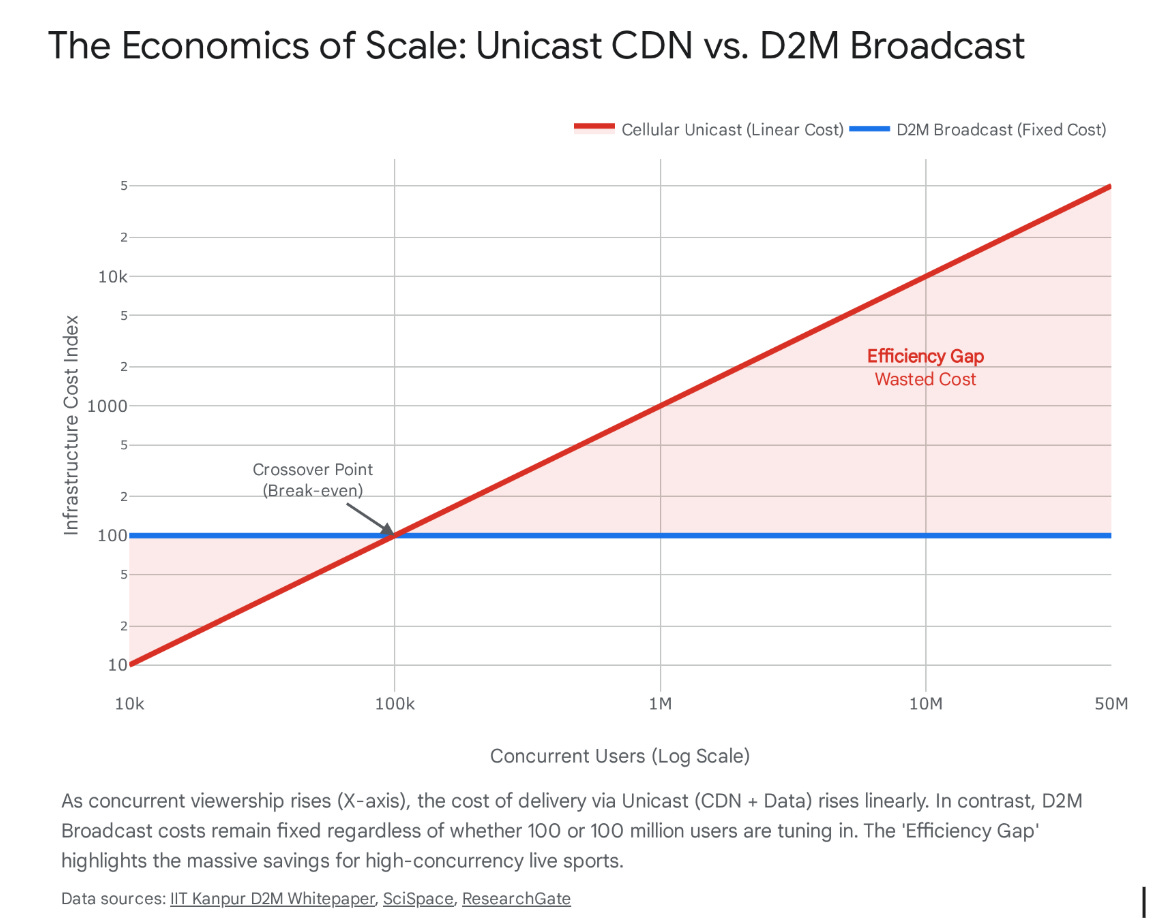
In a unicast network (4G, 5G), every user who tunes into a live stream requires a dedicated data tunnel from the cell tower to their device. If a single user watches a 4K stream, they consume roughly 25 Mbps of bandwidth. If one thousand users in a single cell sector try to watch that same stream, the tower must deliver 25,000 Mbps of aggregate throughput. This is physically impossible for most cell sites, which share a finite backhaul capacity.
When a cricket match like the IPL Final draws 30 million concurrent viewers on a platform like JioCinema, the network does not just bend; it fractures. The “buffer face” - the frozen screen of a pixelated bowler mid-delivery - is not a technical glitch; it’s the inevitability of unicast architecture. As user density increases, the cost of delivery rises linearly (or exponentially due to congestion management), while the quality of service degrades.
Here’s the story gets interesting:
D2M inverts this equation.
It utilizes Broadcast Mode, a one-to-many architecture where the signal is transmitted once. Whether that signal is received by one person or one billion people, the spectrum usage is identical, and the cost of transmission is fixed. The marginal cost of adding the billionth viewer is effectively zero.
The deployment of D2M in this band was initially met with fierce resistance from the telecom lobby, represented by the Cellular Operators Association of India (COAI). Their arguments:
first, that the spectrum should be auctioned for mobile data (IMT)
second, that high-power broadcast transmitters would cause harmful interference to adjacent mobile networks.
These concerns were put to the test in a rigorous series of trials commissioned by Prasar Bharati and conducted by the Indian Institute of Technology (IIT) Kanpur in late 2025. The tests, performed at the TEC-designated Aracion Technology laboratory in Bengaluru, were exhaustive:
Thermal performance: One of the more nuanced concerns was that the continuous processing of a broadcast signal would overheat mobile devices. Engineers used Fluke TiS60+ thermal cameras to monitor device temperatures over 180-minute playback sessions. The results were definitive: D2M-enabled smartphones maintained back-side temperatures between 33.6°C and 34.7°C, virtually identical to the thermal profile of standard cellular streaming.
Zero desensitization: The interference tests were equally conclusive. Even with a 40W D2M transmitter blasting nearby, the receiver sensitivity of the mobile devices remained unchanged at -90 to -92 dBm. There was “zero desensitization” of the 4G/5G radio, meaning the two technologies can coexist without degrading the user’s cellular experience.
This scientific validation has removed the primary technical hurdle, shifting the battleground from physics to policy.
In selecting the technology standard for D2M, India made a strategic pivot away from the European legacy. While much of the world was looking at 5G Broadcast (an extension of the LTE standard), India chose ATSC 3.0 (branded globally as NextGen TV). This decision is fundamental to understanding the geopolitical and industrial ambitions of the project.
Why ATSC 3.0?
ATSC 3.0 is distinct from its predecessors because it’s the world’s first broadcast standard built entirely on the Internet Protocol (IP) backbone.
Data, not signals: if traditional TV sends signals, ATSC 3.0 sends packets. This means the broadcast pipe is natively compatible with the internet. A D2M-enabled phone receives data packets that look exactly like the data packets it gets from Wi-Fi or 4G. This allows for seamless “hybrid” applications where the video (heavy payload) comes via the broadcast chip, but the overlay graphics, voting buttons or personalized ads come via the cellular connection.
OFDM modulation: The standard uses Orthogonal Frequency Division Multiplexing (OFDM), the same modulation scheme used in 5G and Wi-Fi. This provides it with exceptional resistance to the Doppler effect, ensuring that the signal remains stable even when the viewer is moving at high speeds - such as on a train or in a car.
The Bootstrap: A unique feature of ATSC 3.0 is the “Bootstrap” signal - a highly robust, low-level preamble that can be detected by a device even in deep sleep or poor signal conditions. This allows the network to “wake up” the phone for emergency alerts, a key requirement for the Indian government’s disaster management protocols.
The 5G broadcast stumble
The alternative path was 5G Broadcast. This standard is championed by the 3GPP and European entities. However, its roadmap has been plagued by delays.
Qualcomm’s timeline: Major chipset manufacturers like Qualcomm have indicated that mass-market 5G Broadcast chips will not be available until 2028. A three-year lag is unacceptable to Indian policymakers who see the “video crunch” as an immediate crisis.
European hesitation: The European ecosystem is fracturing. While trials have occurred in France (TDF) and Austria (ORS), major broadcasters like Germany’s ARD recently decided against rolling out 5G Broadcast, citing ecosystem immaturity.
India’s opportunity: By adopting ATSC 3.0 now, India is attempting to leapfrog the Western roadmap. The goal is to create a domestic ecosystem of devices and chips that is ready today, rather than waiting for a global consensus that may be years away.
The “Make in India” silicon: Saankhya Labs
Central to this strategy is Saankhya Labs, a Bengaluru-based semiconductor company (now a subsidiary of Tata-owned Tejas Networks). They have developed the Pruthvi-3 and SL-3000 chipsets - indigenous Software Defined Radio (SDR) solutions capable of decoding ATSC 3.0.
Owning the silicon IP means India is not beholden to foreign licensing fees or supply chain whims. The “Pruthvi” chip is a “Make in India” success story, demonstrating that Indian firms can move up the value chain from software services to deep-tech hardware design.
The ambition extends beyond India. With the Global South (Latin America, Africa) looking for cost-effective digital broadcast solutions, India hopes to export its D2M stack. Brazil, which is also exploring ATSC 3.0 components for its TV 3.0 standard, is a prime target. The narrative is clear: India is building a “frugal innovation” standard for the next billion users, bypassing the expensive, patent-heavy roadmaps of the West.
The “Spoiler Effect” and the latency crisis
In India, cricket is not just a sport. It’s a secular religion. And the current digital experience of it is deeply flawed.
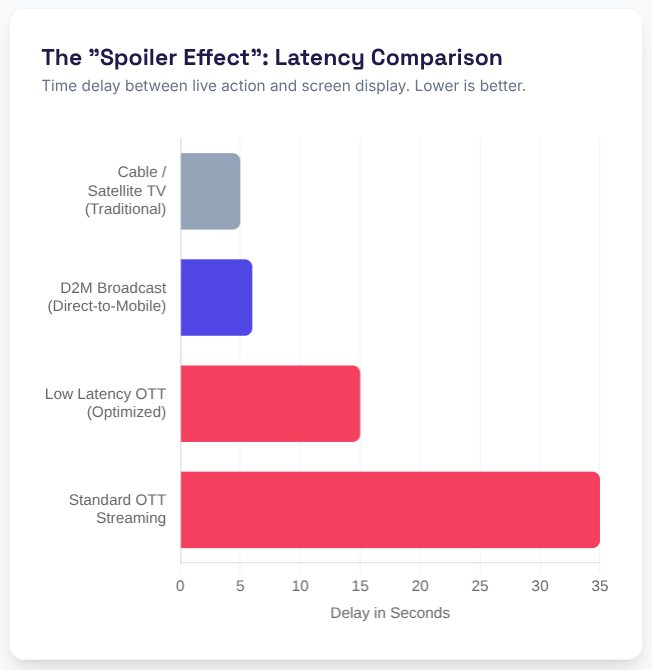
During the IPL, neighborhoods often erupt in cheers for a wicket or a six, spoiling the moment for neighbors watching on JioCinema or Hotstar who are still seeing the bowler’s run-up. This 30-second lag destroys the real-time social fabric of the game.
For the sports bettor, the social media addict or for the fan shouting from their balcony, latency is the only metric that matters. The transition from analog cable to digital streaming has been a regression in this regard.
Satellite/Cable Latency: Typically 3-5 seconds behind live action.
OTT Streaming (HLS/DASH): Typically 20-45 seconds behind.
This gap creates the “Spoiler Effect.”
The latency in OTT is structural. It is caused by the way HTTP streaming works: video is chopped into “chunks” (usually 6-10 seconds long) and the player must buffer several chunks before playback begins to ensure smooth viewing.
D2M bypasses this entirely.
By using a broadcast stream, it eliminates the handshake protocols and buffering requirements of the HTTP web. The result is “glass-to-glass” latency of under 5 seconds - comparable to, or even faster than, traditional satellite TV.
The Sports Broadcasting Signals Act
In 2007, the Indian government passed the Sports Broadcasting Signals (Mandatory Sharing with Prasar Bharati) Act. This law mandates that private broadcasters (like Star Sports or Sony) must share the live feeds of “sporting events of national importance” with Prasar Bharati.
The law was designed to ensure that citizens who could not afford cable TV could still watch India play cricket on the terrestrial Doordarshan network or the FreeDish satellite platform.
If D2M is notified under this Act, the implications are profound.
It would mean that private broadcasters, who pay billions of dollars for exclusive rights to the IPL or ICC World Cup, would be forced to share those feeds with Prasar Bharati’s D2M network.
And here comes the silent elephant in the room
The Board of Control for Cricket in India (BCCI), the richest cricket body in the world, is the elephant in the room. Their revenue model depends entirely on the bidding wars between private players. If the “Mandatory Sharing” clause is expanded to mobile, the BCCI’s asset value is directly threatened. While they have yet to issue a formal public stance, industry insiders suggest a fierce lobbying effort is underway behind closed doors to exempt D2M from the mandatory sharing list, or to ensure that only “feed sharing” (not revenue sharing) occurs.
The technology works. The spectrum is available. The policy is drafted. But will the devices arrive? This is the “Chicken and Egg” problem that has killed every previous attempt at mobile TV (remember DVB-H or Qualcomm’s MediaFLO?).
The problem is (also) here: the smartphone obstinance
Global smartphone giants like Samsung and Apple are notoriously resistant to hardware fragmentation. They design global devices for global supply chains.
Inside a modern smartphone, every cubic millimeter is accounted for. Adding a D2M receiver chain involves not just the Saankhya chip (which is small) but also a dedicated antenna capable of receiving UHF signals. UHF antennas are physically larger than the high-frequency antennas used for 5G/Wi-Fi.
Integrating this without increasing the phone’s thickness or compromising battery size is a significant engineering challenge.
Adding D2M capability is estimated to add $2-$4 to the Bill of Materials (BOM). In the hyper-competitive Indian market, where margins on budget phones are razor-thin, no manufacturer wants to absorb this cost voluntarily.
Recognizing this resistance, the Indian government is weighing a heavy hand.
The Ministry of Information and Broadcasting (MIB) has floated the idea of mandating D2M hardware in smartphones, similar to how USB-C ports were mandated in Europe or GPS support in India. However, the Ministry of Electronics and IT (MeitY) and the device lobby (ICEA) are pushing back, arguing that such mandates would disrupt India’s growing status as a smartphone export hub.
As a bridge solution, the roadmap includes the development of external USB-C Dongles. Priced at around ₹500-600, these dongles would allow existing smartphone users to plug into the D2M network. While functionally sound, the history of consumer electronics suggests that “dongle-based” ecosystems rarely achieve mass adoption.
Friction is the enemy of usage.
The most promising avenue lies in Feature Phones. Manufacturers like Lava and HMD are developing D2M-enabled feature phones for the ₹2000 price point. This targets the “TV Dark” population - the hundreds of millions of Indians who own a basic phone but do not own a TV set. For this demographic, D2M is not a cool add-on:
it’s their primary window to the visual world
As India moves toward the planned rollout in mid-2026, the D2M initiative stands at a crossroads. But the “buffer-free” World Cup final is technically within reach.
And there are some who don’t like this idea very much.
Love this!